How to Get Your Criminal Record Expunged in Georgia [2025 Updated]

June 2, 2024

If you commit a crime in Georgia, you may be at risk of having a criminal record, which can negatively impact your ability to obtain housing, a job, or a license. Therefore, it may be worth getting your record expunged so that you can live freely and focus on your future. But, it can be a complicated process that may leave people wondering, how to get a criminal record expunged in Georgia. If you wish to remove a conviction from your permanent record so you can work toward a future with more opportunities, your goals may be reachable if you qualify.


What Does It Mean to Expunge or Seal Your Record?

If you are accused of committing a crime or caught committing illegal activity in Georgia, you may be arrested. If your arrest is deemed valid, and you are charged with a crime, a record of your arrest and charges will be logged on your permanent criminal record.


Record expungement means that your criminal record is sealed or hidden from public view, but it is still visible to judicial officials. If your record gets expunged, you can apply for employment, housing, and any licenses you may seek without your criminal history showing on background checks.


In Georgia, there are no distinct procedures for sealing a record or expunging a crime from one’s criminal history; instead, there is only the option of the Record Restrictions Process. When an individual has successfully completed this process and restricted a particular offense from their record, any evidence of the conviction is inaccessible to third parties such as potential employers, landlords, or license boards.


However, restricted records may still be viewable to law enforcement agencies as well as government entities. There can be several benefits from restricting or clearing a criminal offense from your permanent record. Doing this can eliminate any obligations or consequences that are contingent upon the conviction, provide the person with more job and career options without fear of stigma, and remove other limitations a conviction brings, among other upsides.


Which Crimes Are Eligible for Expungement in GA?

The criteria for essentially removing a crime from one’s permanent record can vary from state to state. In Georgia, it’s possible for most arrests and charges to be expunged if the case against you was eventually dismissed, meaning you were not convicted. Some infractions and minor misdemeanor convictions may be eligible for record restriction in Georgia, and a few felonies may also qualify, depending on the circumstances.


Misdemeanor convictions that are not eligible for expungement in Georgia include serious traffic crimes such as DUIs, vehicular homicide, and aggressive or reckless driving, along with convictions for domestic violence and sex crimes against a minor. Felonies that are ineligible for restriction include armed robbery, murder, rape, and aggravated sex crimes.


Even when an offense may qualify for restriction, it doesn’t mean the defendant themself may qualify for the expungement process. Individuals might qualify for record restriction if the charges against them were dropped/dismissed if the conviction was their first crime and only one, if the crime was a minor offense, if the trial didn’t result in a guilty verdict, or if the person has completed their probation for the crime and has not been convicted for at least four years since.


How Likely Is It to Get a Criminal Record Expunged in Georgia?

There are some criminal records that are not eligible for expungement, such as those with violent crimes like murder, rape, or armed robbery; traffic crimes like DUIs and vehicular homicide; or sex crimes like child molestation. However, if your case was dismissed without a conviction or if you committed certain misdemeanors, you may be eligible for expungement. Examples of misdemeanors that may be expunged include:


  • Certain drug charges
  • DUIs that have been dismissed
  • Juvenile crimes
  • Public indecency
  • Felonies that have been pardoned


At The Law Office of Delisa Williams PC, we can inform you if your record is likely to be expunged or not. We have an intricate understanding of the legal system, and we have the patience and competence to inform you of your legal options.


How to Apply for Expungement in Georgia

In order to request that a record of a specific crime be restricted, begin by obtaining a copy of your Criminal Record Report, also called a Georgia Crime Information Center (GCIC) report, which details a comprehensive list of your criminal history. You can usually get a printed copy of this document from your local police department for a small fee.


After getting a copy of your criminal record, proceed to file an official expungement/restriction application with the county prosecutor’s office; the office should be in the county in which you were charged with the offense. The prosecutor will typically take a few weeks to review your application before approving it or denying the request for an expungement.


If the county prosecutor’s office approves your expungement application, it’ll be passed on to the Georgia Bureau of Investigation (GBI). The GBI oversees all of the state’s record restriction matters. The bureau will likely charge a small processing fee, and your expungement request will then be finalized and honored.

What Is the Criminal Record Expungement Process in Georgia?
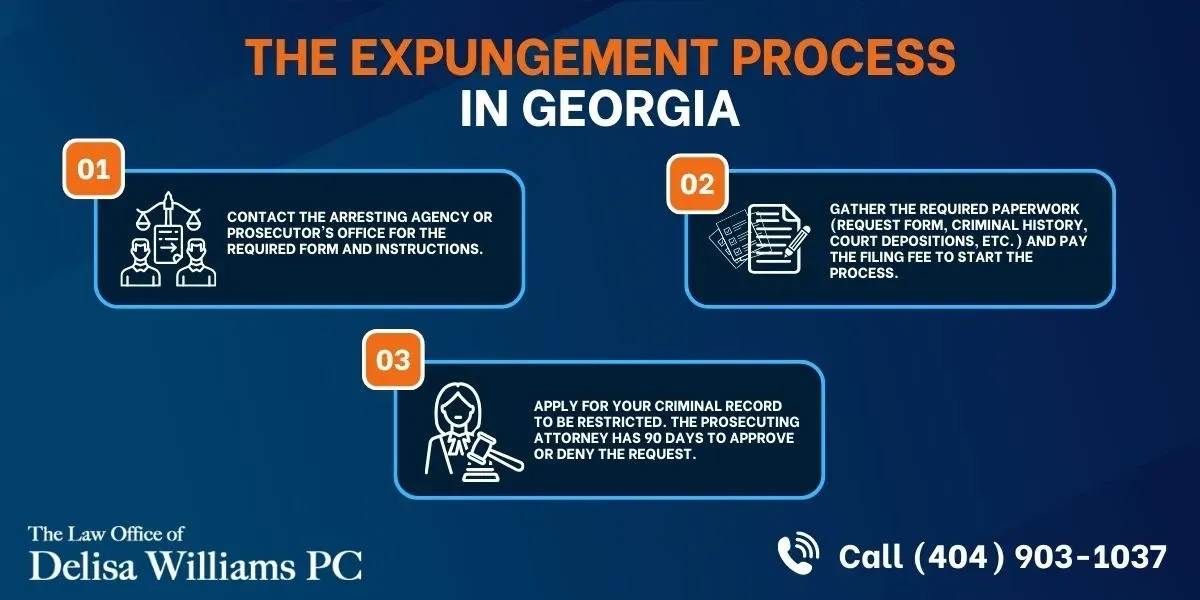
An advertisement for the expungement process in georgia

Before you begin the process, it is important to note the date that your arrest took place, as it impacts the agency you will consult to approve your request. For instance, if the arrest happened before July 1, 2013, the arresting agency can help you with your request. However, if it was on or after July 1, 2013, then you must work with the prosecuting attorney directly.


An outline of the complete process is as follows:


  1. Initial contact – Speak with the arresting agency or prosecutor’s office to get an understanding of the process.
  2. Gather your paperwork – You will need a request to restrict form if your arrest was before July 1, 2013, or a different form from the prosecuting attorney’s office if it was on or after that date. You will also need to pay the $50 filing fee, as well as any additional paperwork surrounding your criminal history, court depositions, or other legal paperwork requested.
  3. Apply for your record to be restricted – This is determined by your arrest date. Before July 1, 2013, the process is filling out the request form, having the arresting agency complete their section of the form, and having the prosecuting attorney fill out their section. The prosecuting attorney will have 90 days to give approval or denial of the request.


The process is slightly different if the arrest was after July 1, 2013. Instead of contacting the arresting agency, the entire process is completed through the prosecuting attorney.


When Should I Hire a Lawyer?

You can hire an Atlanta expungement lawyer at any stage of the process, but consulting with a lawyer before submitting a records restriction request may be to your advantage. Your lawyer can educate you on your rights, protect your rights, and defend your rights. Since they are familiar with the laws surrounding your case as well as the judicial system, hiring a lawyer may be your greatest chance of success rather than doing it alone.

FAQs

  • What Crimes Can Be Expunged?

    Most misdemeanors qualify for expungement (or restriction) if the defendant is eligible; qualifying criteria include completing probation and four years have passed with the individual not committing a criminal violation beyond minor traffic infractions. Severe traffic offenses like DUIs, domestic violence crimes, and sex violations are excluded from this. Certain non-violent felonies may be eligible for restriction.

  • How Much Does It Cost to Get Your Record Expunged?

    The total cost of expunging a single record from your criminal history can vary depending on the county and which criminal records are required to obtain, but generally, expenses are around $100 or less for a singular record restriction case. It’s about $25 to acquire one’s GCIC report, $50 to apply with the county’s prosecutor’s office, and another $25 for the GBI to process your case.

  • What Is the Second Chance Act in Georgia?

    The Georgia Second Chance Act is an effort to reduce reentry in the prison system by eliminating certain barriers for ex-criminals. The Act is intended for low-level offenders and those with non-violent misdemeanor charges as well as some felonies. One of the policies is easier access and expansion to record expungement.

  • Will My Expunged Record Show Up on a Background Check?

    Any records that have been successfully restricted or expunged from an individual’s criminal record report will not be accessible to any members of the public who may run a background check on that person. This means any potential employers or landlords can run a background check, and the restricted record will not be included in the report. However, such records may still be viewable by law enforcement and government agencies.

  • How Long Does a Felony Stay on Your Record?

    How long a felony stays on your criminal record depends on the felony offense. Records of an arrest that did not result in a guilty verdict or felony conviction may no longer show up on background checks after seven years have passed. Certain felony convictions may expire and be restricted after four years. Federal law mandates that employers may only obtain information that’s relevant to the job, accurate, and not out of date.

Contact The Law Office of Delisa Williams PC Today

At The Law Office of Delisa Williams PC, we have years of experience in litigating criminal defense cases. We understand that everyone deserves a second chance, and getting your record expunged can be that first step. Contact us today so we can walk you through the legal process and represent you in court if necessary. Our Atlanta criminal defense lawyer looks forward to helping you with your case.


With our legal team engaged, we can thoroughly review your situation and provide you the necessary legal advice you need to successfully navigate your situation.


See Related Posts:

A person in a dark suit with hands in metal handcuffs resting on a wooden table against a dark blue background.
April 9, 2026
Violated probation in Atlanta, Georgia? Learn what happens next, your legal options, and how a probation lawyer can help you avoid jail time. Call today.
Judge with gavel on desk in courtroom. Jury and spectators in background.
March 12, 2026
Convicted of a crime in Georgia? Learn your post-conviction options, including appeals, probation, parole, and motions for a new trial with an Atlanta defense attorney.
A stethoscope and gavel on a book titled
February 12, 2026
Learn when to contact a personal injury attorney in Atlanta and why timing matters when protecting your rights after an accident.
Two people in suits shaking hands at a desk with a gavel, scales of justice, and documents.
January 15, 2026
Do you need a trademark for your business in Georgia? Learn how trademark protection works and when an Atlanta trademark attorney can help.
Damaged blue car on side of road after a collision. Another car driving away in the distance.
November 28, 2025
What to Do Immediately After a Car Accident in Atlanta, GA
Gavel, scales of justice, and handshake on a table in a courtroom, symbolizing legal agreement.
October 31, 2025
Expungement vs. Record Restriction in Atlanta, GA: What’s the Difference?
Shot glass with liquor, lemon, and car keys on a bar, suggesting drunk driving.
September 30, 2025
First-Time DUI in Georgia: Penalties and Defense Options
A judge 's gavel is sitting on top of a black table.
May 9, 2025
Facing an adverse judgment can be an overwhelming experience. A litigant may be left feeling scared, frustrated, and unsure of what to do. Luckily, this does not necessarily mean the end of the court process. It is important to know there are options. Here, we explore the grounds for a motion for a new trial in Atlanta and common reasons and requirements. If there are legal means to do so, the court can grant a new trial. In 2022, for example, an Atlanta man was granted a retrial based on an insufficiency of evidence during initial proceedings and was later acquitted. A motion for a new trial can be an important legal mechanism. Appeals and New Trials In the post-trial stage, it can be confusing to understand the proper steps to take. One of the first things that must be done is to decide if a motion should be filed for a new trial or an appeal. While similar, these two motions are fundamentally different. A motion for an appeal argues that there was a problem in the court process which caused a defect in the court process. This can include things like ineffective counsel or issues with evidence. Importantly, an appeal seeks to move the case to a higher court, in effect making a request to take it out of the hands of the court of first instance. A motion for a new trial is, in effect, a request to the ruling judge to try the same case again. While this motion, like an appeal, argues that problems occurred during initial proceedings, it does not seek to move the case to the higher courts. Rather, it submits reasons that a new trial should take place under the initial judge, and is grounded on the submission of exculpatory information. Grounds for a Motion for a New Trial A person submitting a motion for a new trial, or “movant,” can make their claim on several grounds. This must be done within 30 days of the initial court judgement. In the state of Georgia, this motion is made possible by Article 2, Chapter 5, Title 5 of the Georgia Code ( §§ 5-5-20 ), which recognizes the following as legitimate grounds for a new trial: I nsufficiency of evidence. This could mean several things, including any errors committed by the court through illegal admissions of evidence or exclusion of exculpatory evidence. Newly discovered evidence. For this to be valid, the evidence must have come to the movant’s knowledge after the trial, and a legitimate reason must be offered for the party not being aware of it before then. The evidence should be consequential and likely to have a bearing on the original outcome of the initial court decision. A contradiction between the judgment and the evidence presented. This occurs when the legal judgment of the court stands in direct conflict or contradiction with the facts presented to the court. This can happen when evidence is interpreted mistakenly or when the evidence presented is clearly exculpatory. Legal errors during trial proceedings. Sometimes errors happen in the pre-trial or trial procedure. If there was impropriety in things like jury instructions, use of inadmissible evidence, or other irregularities that can be shown, there may be a legitimate reason for a new trial. Atlanta Court Backlogs As of June 23, 2023, Fulton County’s Magistrate Court reported over 307,000 case filings since January 1, 2019, with approximately 171,010 landlord-tenant cases. Of these, 14,643 remained open, with 6,952 awaiting a trial date, indicating a significant backlog in eviction-related cases. Court backlogs can delay dates for setting retrials. FAQs Q: How to Win a Motion for a New Trial? A: To be successful in a motion for a new trial, you should be prepared with your filings and justifications. Drafting the motion is crucial. Clear, precise justifications must be given. If, for example, there is new evidence, it must be shown that it serves an exculpatory function. Likewise, justification must be given for it not having been included previously. Being prepared and understanding the guidelines are fundamental when filing a motion for a new trial. Q: What Are the Grounds Upon Which a Court May Grant a New Trial? A: In the state of Georgia , under Title 5 of the Georgia Code, a court may grant a new trial due to newly discovered evidence, problems with the initial evidence presented at the initial trial, and any legal errors that can be shown to have been made as well. In addition, if it can be shown there was a contradiction between the judgment and the evidence presented in the original case, a motion may be granted. Q: What Is the Federal Rule for a Motion for a New Trial? A: Under Federal Rule of Civil Procedure 59 , a motion for a new trial in a federal court must be filed within 28 days after the entry of judgment. The court may grant a new trial if the verdict is contrary to the weight of evidence, involves legal errors, or other reasons that justify a new proceeding, such as juror misconduct or newly discovered evidence. The decision to grant a new trial is within the trial court’s discretion. Q: Can an Attorney Help Get a New Trial in Atlanta? A: A skilled lawyer can help secure a new trial in Atlanta by filing a motion within 30 days of the judgment, demonstrating errors like insufficient evidence, legal mistakes, or juror misconduct. They can gather new evidence, such as uncalled witnesses or exculpatory material, and argue how trial irregularities violated the defendant’s right to a fair trial. If denied, an experienced attorney can appeal to a higher court, leveraging their skills to navigate strict deadlines and complex legal requirements. Speak with an Experienced Lawyer Today Seeking a new trial is a legitimate option should new evidence or extenuating circumstances arise. The process can be complex, and it is critical to have sound legal advice. At The Law Offices of Delisa Williams, PC , our attorneys have a track record of success when it comes to representing and advocating for clients. Contact us today to discuss developing a motion for a new trial. See Related Posts: 2025 Eligibility for Record Restriction in Atlanta: Do You Qualify The Benefits of Record Restriction in Georgia: A Second Chance at Success 
A group of people are sitting around a table with laptops and papers.
May 9, 2025
If you are charged with a crime in Georgia, you may face a range of consequences, from serving jail time, paying fines, being on probation, or being ordered to do community service, depending on the crime. However, another penalty is having a criminal record, which can not only stain your reputation but also impede you from obtaining a range of opportunities. Therefore, if you have a criminal record, you should understand how eligibility for record restriction in Georgia works. At The Law Office of Delisa Williams, PC, we provide criminal defense for a myriad of crimes . Whether you have been charged with a misdemeanor or a felony, our lawyers have top-notch skills, extensive experience, and provide the individualized attention necessary to help our clients reach successful outcomes. What Is Record Restriction? If you commit a crime, it will likely appear on your permanent criminal record. Criminal records in Georgia are maintained by the Georgia Crime Information Center (GCIC) and contain identifying information, arrest records, and judicial dispositions. These records are viewable by law enforcement agencies, courts, certain public agencies, employers, and the offenders themselves. According to the Prison Policy Initiative, roughly 38% of adults in Georgia have a criminal record . Of the over 200,000 adult arrests reported statewide, many were for misdemeanors that may qualify for restriction. Because criminal records are viewable to public agencies and employers, having a record can impede your ability to obtain employment, certain licenses, educational opportunities, and even housing. This is why many people seek to get their records expunged or restricted, also known as record sealing. This distinction is beneficial to many offenders because it means that even though the record is still accessible to courts and criminal justice agencies, it is hidden from the public, helping offenders regain their abilities to obtain jobs, housing, licensing, and educational opportunities. Georgia Record Restriction Laws In Georgia, offenders can get up to two misdemeanors restricted from their criminal record. Record restriction laws are pursuant to O.C.G.A. §35-3-37, which outlines the procedures for record restriction, eligibility, and other key factors. To get your record restricted in Georgia, you should contact the prosecuting attorney. If your arrest occurred in Georgia , you may need to contact the SOLICITOR'S OFFICE or DISTRICT ATTORNEY'S OFFICE for misdemeanor restrictions or the District Attorney’s Office for felony charges not resulting in conviction. It is wise to hire a criminal defense lawyer to begin the process for getting your record restricted, whether it is done by application or with the prosecuting attorney. Your lawyer can help you navigate your application and help you with other legal complexities when submitting your request. Record Restriction Eligibility Only certain charges are eligible to get their records restricted or limited from public view. Your lawyer at The Law Office of Delisa Williams, PC can help you determine if you qualify, but generally, the following criteria must be met for record restriction in Georgia: Your case ended with a not-guilty resolution. Your sentence was downgraded. Your criminal conviction was an eligible misdemeanor with the following criteria: You completed the terms of your sentence. You have not been convicted of a crime in at least four years, with certain exceptions. You do not have any pending charges. Generally, felonies are not eligible for restriction by Retro-Active First Offender is a viable tool in removing certain felonies. However, some crimes that are not eligible for record restriction, pursuant to O.C.G.A. §35-3-37, and include: the Misd. not eligible for record restriction are Family violence simple assault and battery, with the exception of youth offenders Family violence stalking Child molestation Public indecency Sexual battery Penalty for Attempting to Obtain Restricted Records The purpose of the record restriction law is to provide for the sealing of criminal records so that offenders have a second chance at life without obstacles. Therefore, violating this law by attempting to view or obtain restricted records is met with consequences. Specifically, if a person illegally obtains or even attempts to obtain sealed or restricted records, they may be met with the following penalties: Paying fines up to $5,000 Serving up to 2 years in jail Or both penalties These penalties also apply to individuals who disclose or attempt to disclose security and privacy methods related to restricted records and other criminal justice information. FAQs Q: How Do I Get My Record Restricted in Georgia? A: The process for getting your record restricted in Georgia depends on your case outcome. If your case met non-conviction criteria, such as getting dismissed or resulting in acquittal, then restriction occurs automatically if you were arrested after July 1, 2013. Nevertheless, following up with the prosecutor is recommended. However, if you were arrested before July 1, 2013, you must fill out an application and submit it to the arresting agency. Q: What Is the New Law for Restricting Convictions in Georgia? A: Georgia’s new record restriction law, Senate Bill 288 , took effect on January 1, 2021. It allows those with certain misdemeanor convictions to restrict those records from public view if they have had no new offenses for four years. The law aims to remove barriers to opportunities, such as employment, housing, and education. Although the records are limited from public view, criminal justice agencies and judicial officials are still able to view the records. Q: What Qualifies for Restriction in Georgia? A: Only certain records qualify for restriction in Georgia. First, typically, only misdemeanors and only certain misdemeanors are eligible for restriction. Specifically, to be eligible for record restriction, you must have met the following criteria: Your conviction must have ended in a not-guilty disposition. You must have completed your sentence. You must not have been convicted of a crime in four years. You must not have any pending cases. Q: Do Felonies Go Away After 7 Years in Georgia? A: No, there is no specific law that states felonies go away after seven years in Georgia. Generally, felonies permanently remain on your record. To get your record expunged or permanently cleared, you should contact a lawyer to advise you of the process. However, certain records can be restricted if they meet eligibility requirements and if you go through the proper channels to request the restriction. Contact an Experienced and Fierce Lawyer Today If you believe your criminal record is eligible for restriction, you should contact us right away . You deserve a second chance and the ability to seek employment, housing, and other opportunities without the barrier of a record. At The Law Office of Delisa Williams, PC, we are here to help you get your life on track and earn your freedom. See Related Posts: Falsely Accused of a Crime in Georgia How Much Does a Criminal Defense Lawyer Cost in Georgia? Grounds for a Motion for a New Trial in Atlanta: Common Reasons and Requirements
Gun. crimes
March 19, 2025
The United States Constitution recognizes the right of citizens to own guns, and each state in the union seeks to balance that right with laws to address public safety. According to World Population Review, approximately 49.2% of Georgia residents live in a home with a gun. Georgia gun laws and penalties are designed to protect its residents, and it remains critical that all gun owners understand these regulations. Georgia’s gun laws are some of the most permissive in the country. In the state of Georgia, any “lawful weapons carrier” can carry a handgun on their person, either openly or concealed. They may carry this firearm without a permit in many public places, excluding government buildings, schools, and bars. Who Is Defined as a “Lawful Weapons Carrier” in Georgia? In the state of Georgia, you are considered a “lawful weapons carrier” if you meet the following requirements: You are eligible for a weapons carry license (regardless of whether you have one) in the state of Georgia. You are a resident of a different state and are eligible for a Georgia weapons carry license. You are licensed to carry a weapon in any other state. Who Cannot Possess a Gun in Georgia? While the gun laws in the state of Georgia are considered fairly lax in comparison to other states, certain people are not legally permitted to carry a firearm of any kind. This includes: Anyone under the age of 18. No one under the age of 18 is allowed to buy or possess a gun of any kind. It is also illegal to sell a firearm to anyone younger than 18. Anyone convicted of a felony . It is illegal for anyone convicted of a felony to possess a firearm at any time, anywhere. This includes felonies outside of the state of Georgia as well as within. Anyone convicted of certain misdemeanors. Specific misdemeanors, such as domestic abuse , can revoke your right to possess a firearm. Anyone who has been adjudicated or legally deemed to have mental illness(es). If you have been adjudicated as mentally ill or are legally considered a danger to yourself and/or others, you may not legally be allowed to carry a firearm. As with most other criminal penalties, monetary fines and jail time are both potential penalties for violating gun carrier laws in the state of Georgia. If you have been accused of unlawful weapon possession, hiring an Atlanta criminal defense lawyer is an important move you can make to clear your name. If you want to avoid penalties, such as fines and jail time, having a skilled lawyer on your side can make or break your case. What Are Some of the Defenses Against Gun Carrier Violation Charges Facing any kind of criminal charges can be stressful, but several types of defenses may potentially lead to the charges being lessened or dropped. Here are some examples: Lack of possession or knowledge. An example of this would be an unknowing and non-carrying person in a car with a friend who is armed. When pulled over by law enforcement, they do not inform the police about their weapon, and the police find it in the backseat. In this case, you would need strong evidence of non-involvement to avoid being successfully prosecuted. Location misidentification or lack of notice. Carrying in prohibited places is illegal, but a skilled attorney can argue that you were unaware of those restrictions or that they weren’t clearly identified. Lack of intent or notice may not clear you of wrongdoing, but it can weaken the prosecution’s case. Lack of evidence. Evidence is a key part of building a compelling case, and if there isn’t enough applicable evidence, the case may not hold up in court. Having an experienced Atlanta gun crime lawyer advocating for you can help you navigate your difficult situation. The team of skilled lawyers at The Law Office of Delisa Williams PC is ready to help you build a compelling case against your charges and assist you every step of the way. FAQs Q: What Is the Minimum Sentence for Illegal Gun Possession in Georgia? A: The minimum sentence for illegal gun possession can vary in the state of Georgia as the result of several variables involved in your case. Having a defense lawyer advocating on your behalf can be a helpful tool when pursuing the minimum sentence or advocating to be cleared of all charges. Q: Can You Carry a Loaded Gun in Your Car in Georgia Without a License? A: In the state of Georgia, you are legally allowed to carry a loaded gun in your car without having a license as long as you are not prohibited by law, and it must be out in the open. For example, if you have been convicted of any felonies, you would be prohibited from possessing a firearm of any kind. Q: Do You Have to Tell a Cop You Have a Gun in Georgia? A: It is always wise to inform law enforcement of any weapons you have. If a police officer pulls you over, you should keep your hands where the officer can see them and respectfully inform them of the weapons you have in your car and/or on your person. This shows them that you are not a threat, that you are cooperating, and that you have no wish to escalate the situation. Q: Can Gun Charges Be Dropped in Georgia? A: It is possible for gun charges to be dropped in Georgia , which is why you need a skilled criminal defense lawyer on your side. Because they understand the judicial system, they can craft a strong defense against your charges. A skilled attorney knows the most effective strategy to employ on behalf of their client. Get More Information Today Facing criminal gun charges can be an overwhelming and confusing experience. Fortunately, you do not need to face your impending legal proceedings alone. At The Law Office of Delisa Williams PC , an accomplished team of lawyers is ready to take on your case. Contact us today for a consultation. See Related Posts: Falsely Accused of a Crime in Georgia How Much Does a Criminal Defense Lawyer Cost in Georgia? How To Get Your Criminal Record Expunged in Georgia Grounds for a Motion for a New Trial in Atlanta: Common Reasons and Requirements